
Next-Generation Content Authoring Platform
Solving the decades-old challenge of truly reusable learning content — a metadata-driven authoring system designed to make courses modular, context-aware, and scalable across an entire university.
My Role
- Strategic UX vision for the authoring system within a cross-discipline team of 4
- Technical advisor on platform architecture bridging UX and engineering
- System analysis, user flows, wireframes, and prototyping across 4 integrated authoring workflows
- Design pattern development for builder UIs, informed by prior experience with similar systems
- Stakeholder presentations to leadership
- 6-month aggressive timeline from concept to design
Results
Architecture Strategy Completed
Defined the complete authoring platform strategy across 4 integrated workflows
Novel RLO Solution
Developed Context Objects — a new approach to the decades-old reusable learning object problem
Metadata Architecture Designed
Created the metadata structure connecting content, pathways, assessments, and achievements
Builder Patterns Established
Wireframed patterns and anti-patterns from prior experience to give design teams proven starting points
The Challenge
The educational ecosystem relied on machine learning and rich metadata to create associations between all components. Existing authoring systems were not up to the task. They could create content, but could not associate the metadata our system needed. They were not designed for reusable, interchangeable modules.
Traditional LMS platforms are entirely self-contained: content is authored, delivered, assessed, and achievements stored all within monolithic systems not designed to be broken apart. The university’s existing systems were brittle and at capacity. We needed an authoring platform built from the ground up to support the metadata-driven, modular architecture the ecosystem demanded.
The Goal
Build a content authoring platform where every piece of content carries rich metadata, courses are assembled from genuinely reusable components, and the same content can serve multiple disciplines without sacrificing relevance. The platform needed to support not just course creation, but assessment authoring, pathway assembly, and the metadata management that ties everything together.
The Constraints
| Constraint | Impact |
|---|---|
| Greenfield project | No existing foundation to build on |
| Contract developers | Part-time, external team with limited availability |
| Six-month deadline | Aggressive timeline from concept to design |
| Built on Alpha | Extending earlier pathway work from the ecosystem POC |
Our Users
The authoring platform served two distinct user groups across a phased rollout. Phase 1 focused on the internal specialists who would build and validate the system. Later phases brought in the broader authoring community.
Phase 1 (Primary Users)
| User | Responsibility |
|---|---|
| Assessment Authors | Write assessments, associate skills and competencies, define rubrics |
| Learning Experience Engineers | Assemble pathways, define completion logic, create content placeholders |
| Data Architects | Build and maintain canonical metadata lists and associations |
Later Phases (Secondary Users)
| User | Responsibility |
|---|---|
| Registrar | Approve courses and pathways for achievement requirements |
| Subject Matter Experts | Validate and create content within their domain |
| Faculty and Third-Party Authors | Crowd-sourced content creation at scale |

Platform Architecture
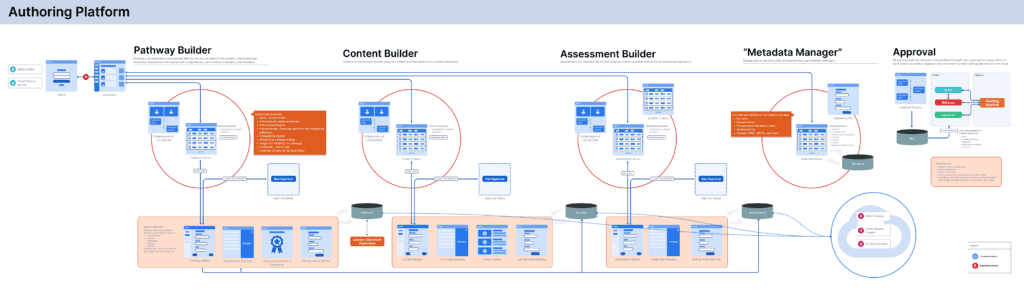
Four integrated workflows form the complete authoring system. Each builds a specific layer of the learning experience — and the design patterns used in one can be reused across the others, since courses, certificates, and degrees are all just sequences of learning modules assembled toward a goal.
| Workflow | Purpose |
|---|---|
| Metadata Manager | Manage canonical data connecting content, pathways, assessments, and achievements |
| Content Builder | Create chunked, reusable learning modules with rich metadata |
| Assessment Builder | Build formative and summative assessments with competency mapping |
| Pathway Builder | Assemble content into flexible, logic-driven sequences |

Differentiator #1: Metadata-Driven Architecture
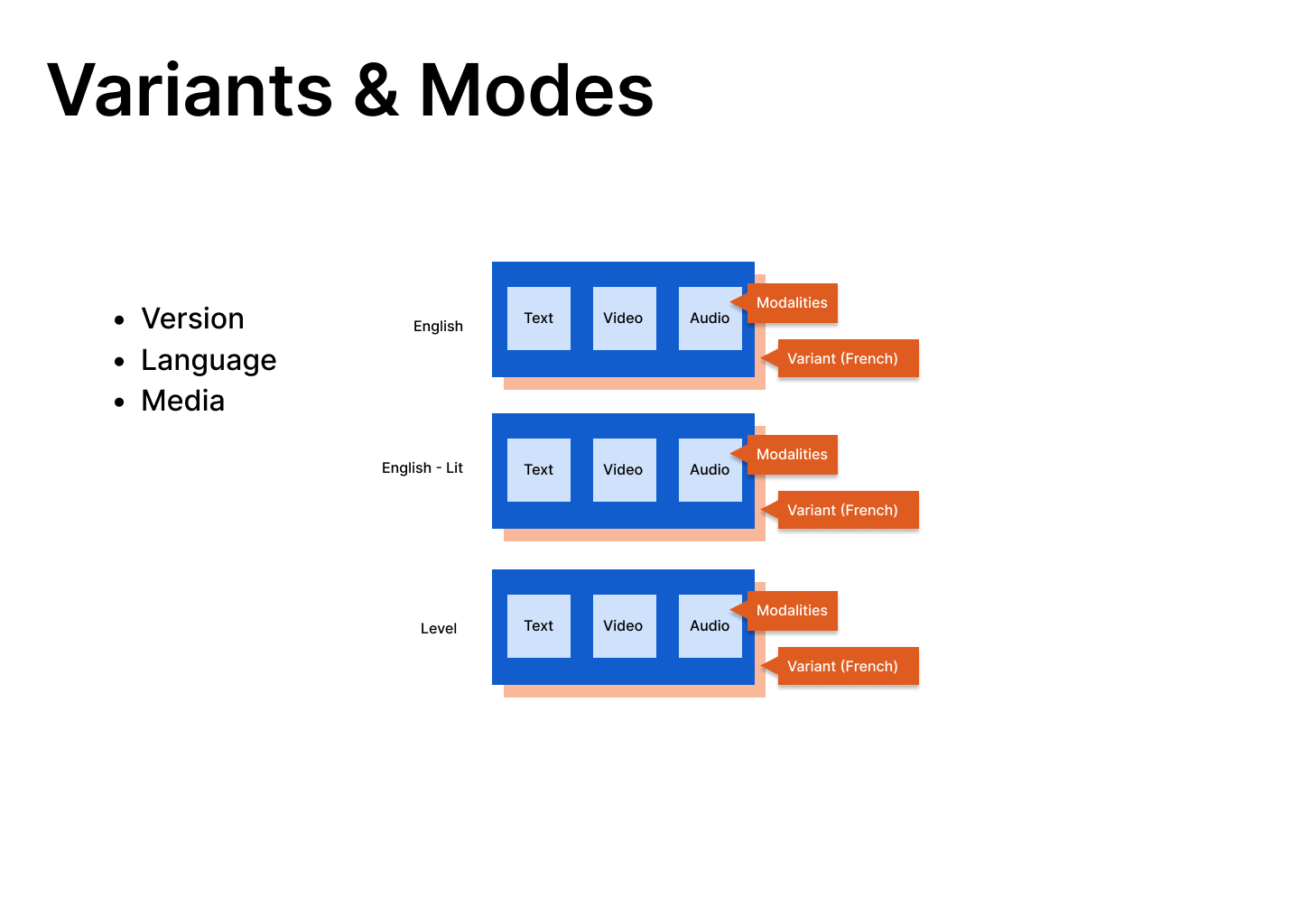
Metadata associations drive the entire ecosystem. The architecture uses canonical, extensible data structures with loose associations via underlying metadata. This means courses and pathways become interchangeable: the system adjusts when learners bring external credit, and a boot camp can substitute for a full course if the competencies match.
The result is pathways that flexibly accommodate each learner’s unique background. Not flexibility bolted on after the fact, but flexibility built into the foundation. Every piece of content knows what it teaches, who it’s for, and how it connects to everything else in the system.
Differentiator #2: Context Objects
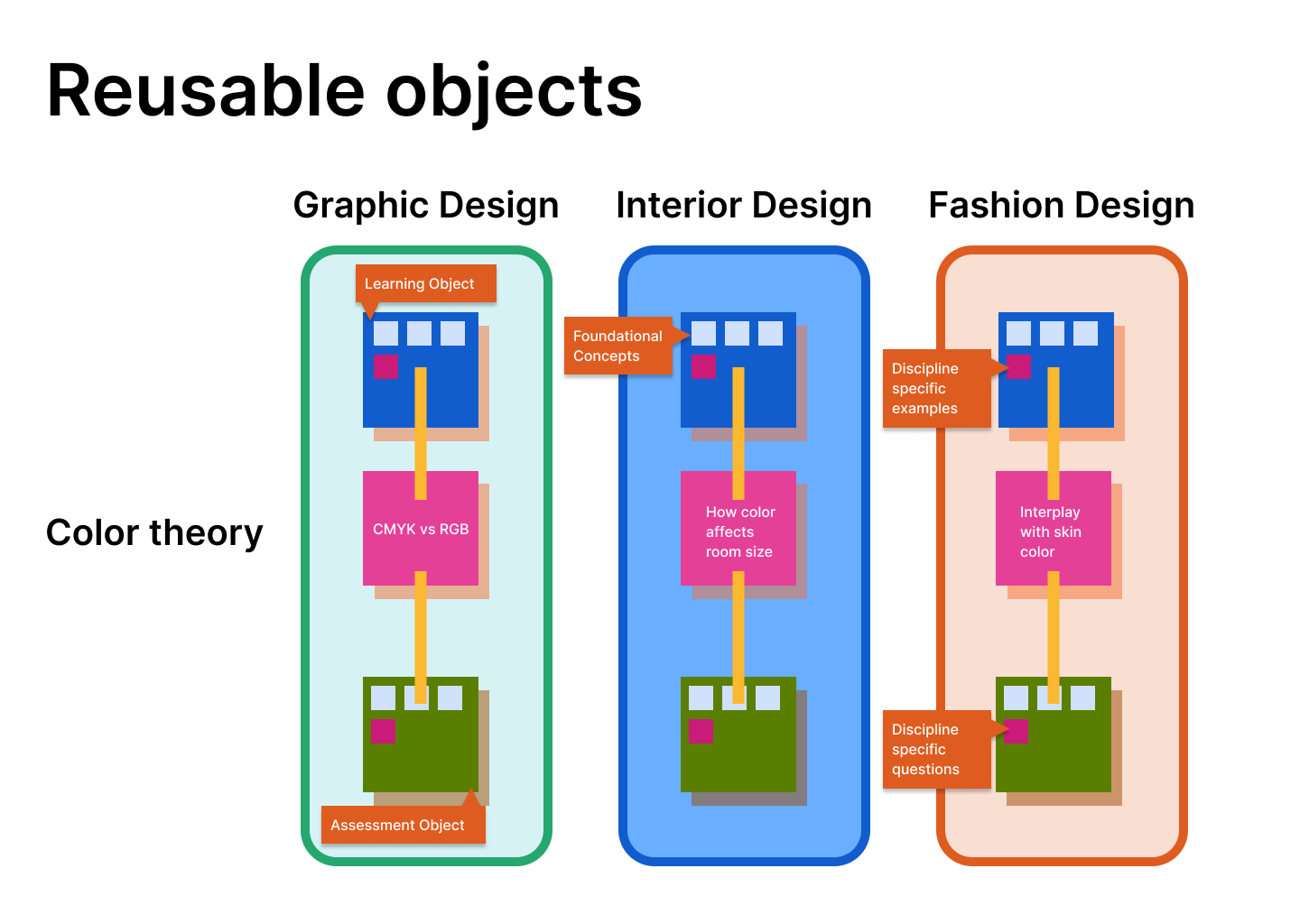
The training and LMS market has tried to solve reusable learning objects (RLO) for decades. I’ve worked for multiple companies attempting this. The problem always comes down to context.
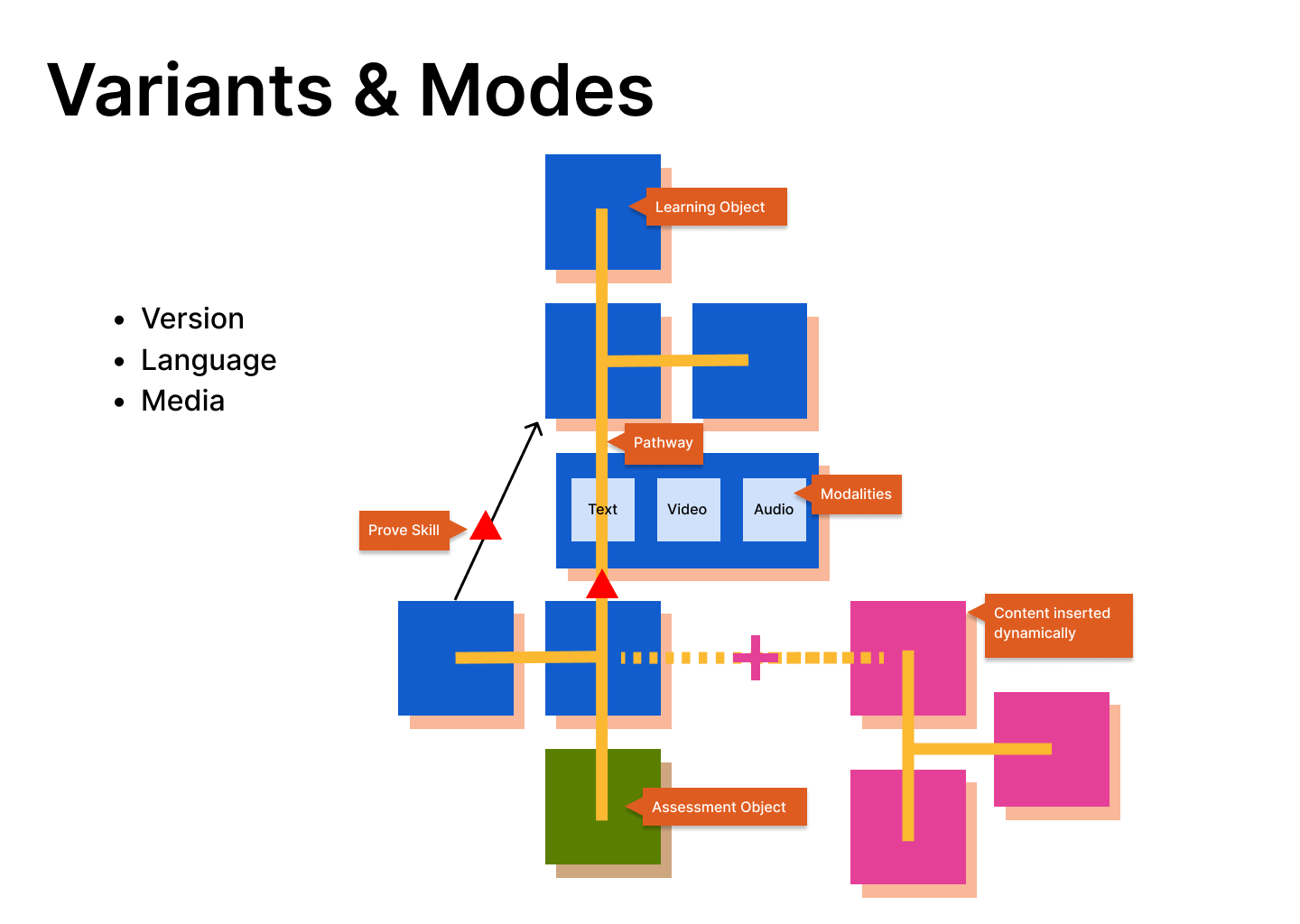
A learning module discussing color theory would be written one way for interior designers, and a different way for graphic designers. You could write content specific to each discipline — two separate courses — or write it so generically that it serves neither audience well. Neither approach scales.
Our innovation: Context Objects. Swap out the discipline-specific examples while keeping core concepts identical, and the same content genuinely serves multiple audiences. Mention Pantone to interior designers? Irrelevant. Discuss fabric sheen with graphic designers? Distracting. Context Objects let the system substitute the right examples for the right audience automatically, without maintaining separate versions of everything.
This was the breakthrough the industry has struggled to find for 20+ years: true reusability without sacrificing relevance.
Pathway Associations
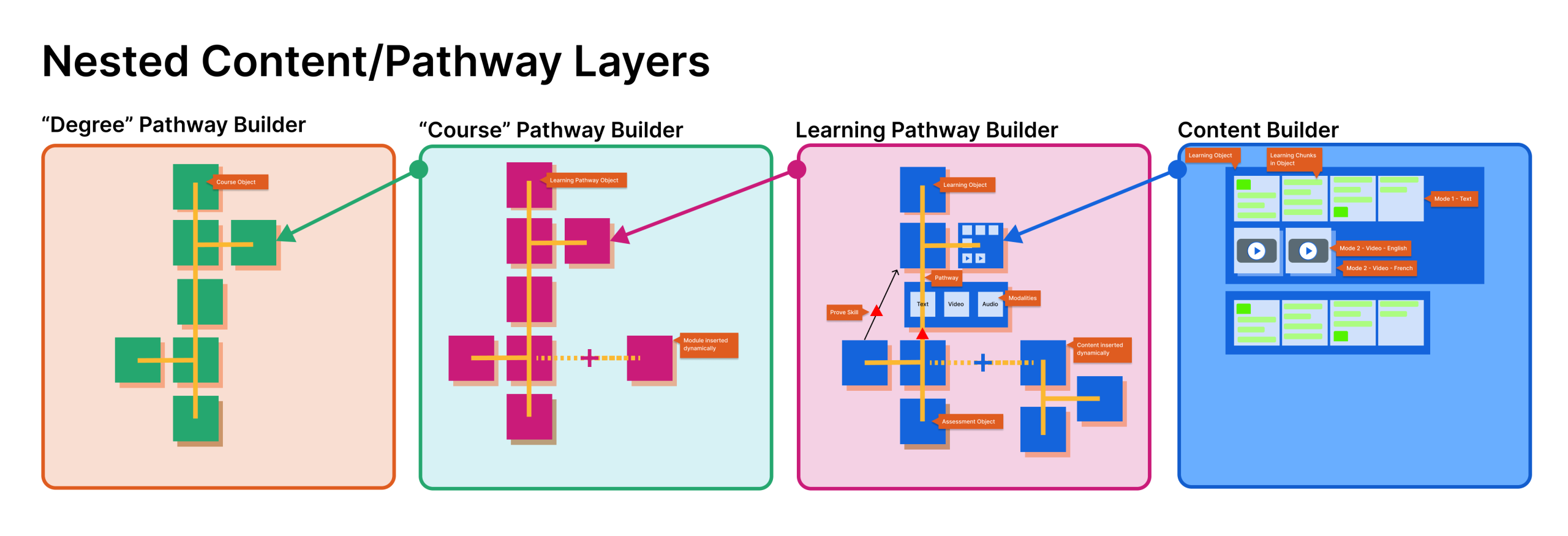
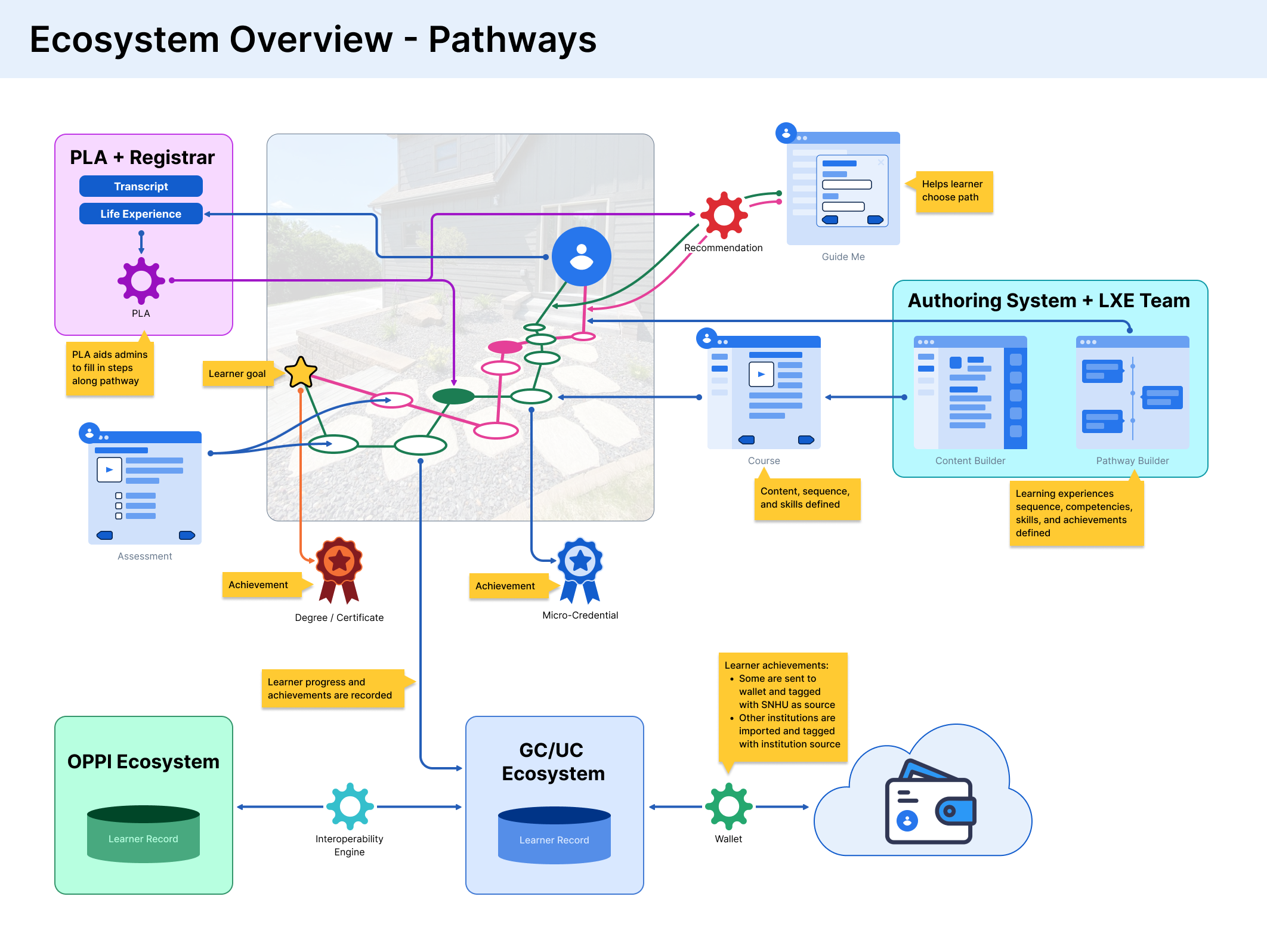
The same authoring logic works at every level of the credential hierarchy. Passing an assessment checks boxes for skills and competencies, which unlock or bypass pathway steps. All steps unlocked means an achievement is awarded. This logic is consistent from the smallest content module all the way to a full degree program.
| Level | Components | Unlocks |
|---|---|---|
| Content Module | Sequence of content items | Module completion |
| Course | Sequence of modules | Course credit |
| Certificate | Sequence of courses | Credential award |
| Degree | Stacked credentials | Degree award |
Builder Patterns
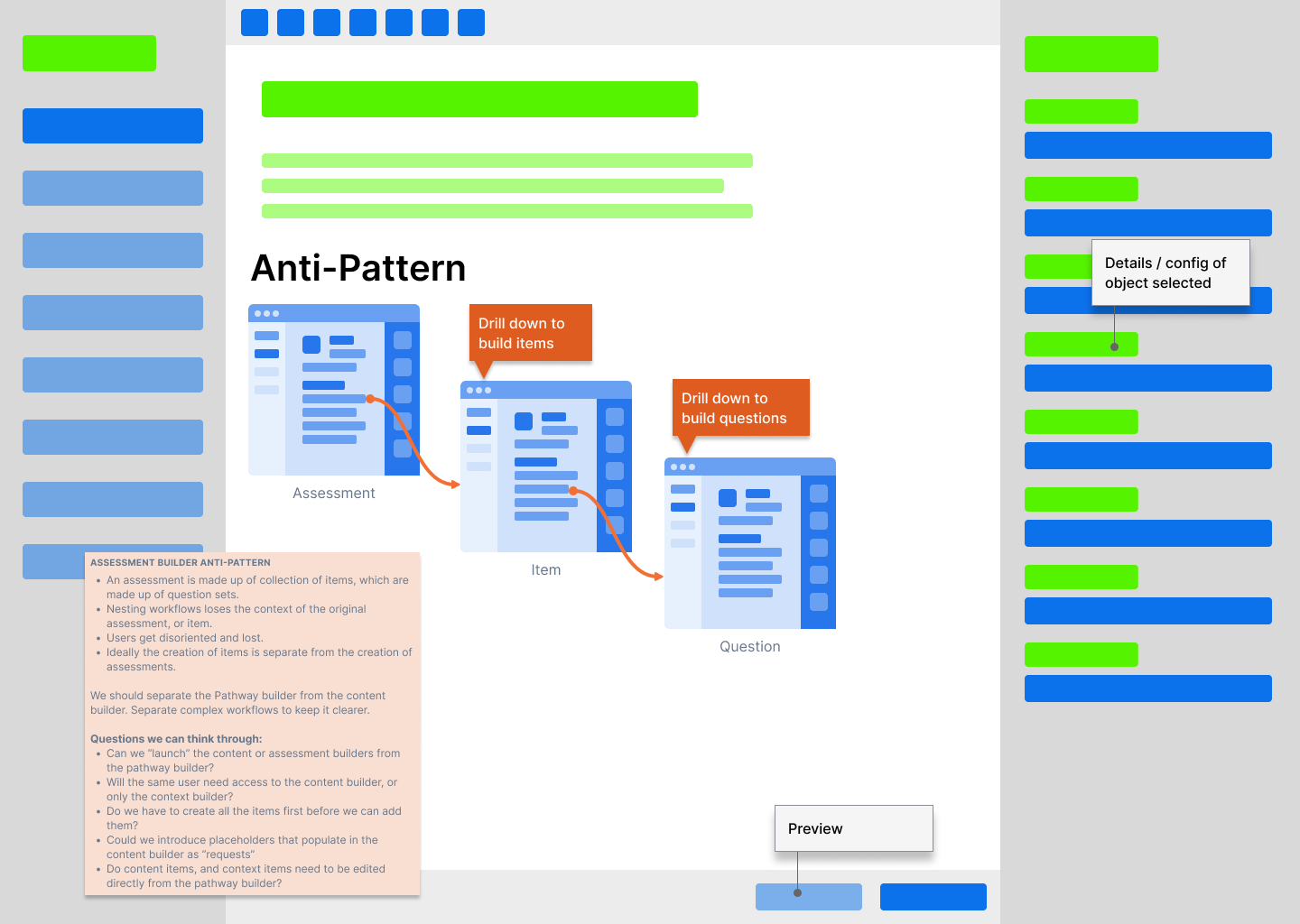
During early design, I wireframed patterns and anti-patterns drawn from similar builder projects throughout my career — drag-and-drop content assembly, inline editing, nested hierarchy navigation, conditional logic authoring. These gave the design teams building out each authoring module a running start: proven interaction models to build on rather than blank canvases to fill.
Builder UIs are notoriously difficult to get right. The same interaction that feels powerful to an expert feels overwhelming to someone authoring their first course. Establishing those baseline patterns early — and documenting what not to do alongside what to do — kept the four workflows consistent with each other even as different designers worked on each.
What We Proved
- Architecture Strategy: Complete authoring platform strategy defined and validated with stakeholders
- Metadata Structure: Management system designed connecting content, pathways, assessments, and achievements
- Context Objects: Novel approach to the RLO problem developed and documented
- Builder Patterns: Design patterns established from prior experience to accelerate team execution
What was planned before the project was discontinued: reusability validation across disciplines, interchangeability testing with metadata-matched content, process fit with real university course creation workflows, and full UX for all four authoring modules.
Reflections
It is unfortunate this project did not get further along. It had potential to impact not only higher education but K-12 and the broader LMS market as well. Reusable learning has been the holy grail of content systems for decades — and our key differentiator was that we were building from the ground up to support it, not trying to retrofit systems never intended for deep interconnectedness.
Architecting content systems for genuine reusability requires getting the metadata architecture right before anything else. If the data model does not support flexibility, no amount of UI design will create it. The metadata layer was the foundation everything else built on: pathways, assessments, achievements, and personalization all depended on it.
Leading a cross-discipline team of four — UX architect, learning experience engineer, data architect, and product manager — on a six-month timeline taught me how to maintain design quality under aggressive constraints. The builder patterns from my prior experience proved invaluable. They gave the team a running start instead of designing from scratch.
Balancing flexibility with practical authoring workflows was a constant challenge. A system that can do anything is a system nobody can use. Every flexibility we added for the learner experience had to translate into a clear, manageable workflow for the people building content.
Context Objects represent a novel approach to a problem the industry has struggled with for 20+ years. While this specific implementation did not reach production, the thinking informs my approach to content architecture problems. The combination of metadata-driven architecture and context-aware content reuse is a pattern that applies far beyond education.
Related Projects
- AI-Powered Educational Ecosystem — The broader system this platform was built to serve
- Learner UX Architecture — How learners consume the content this platform produces
- Achievement Process — How assessments lead to credentials