
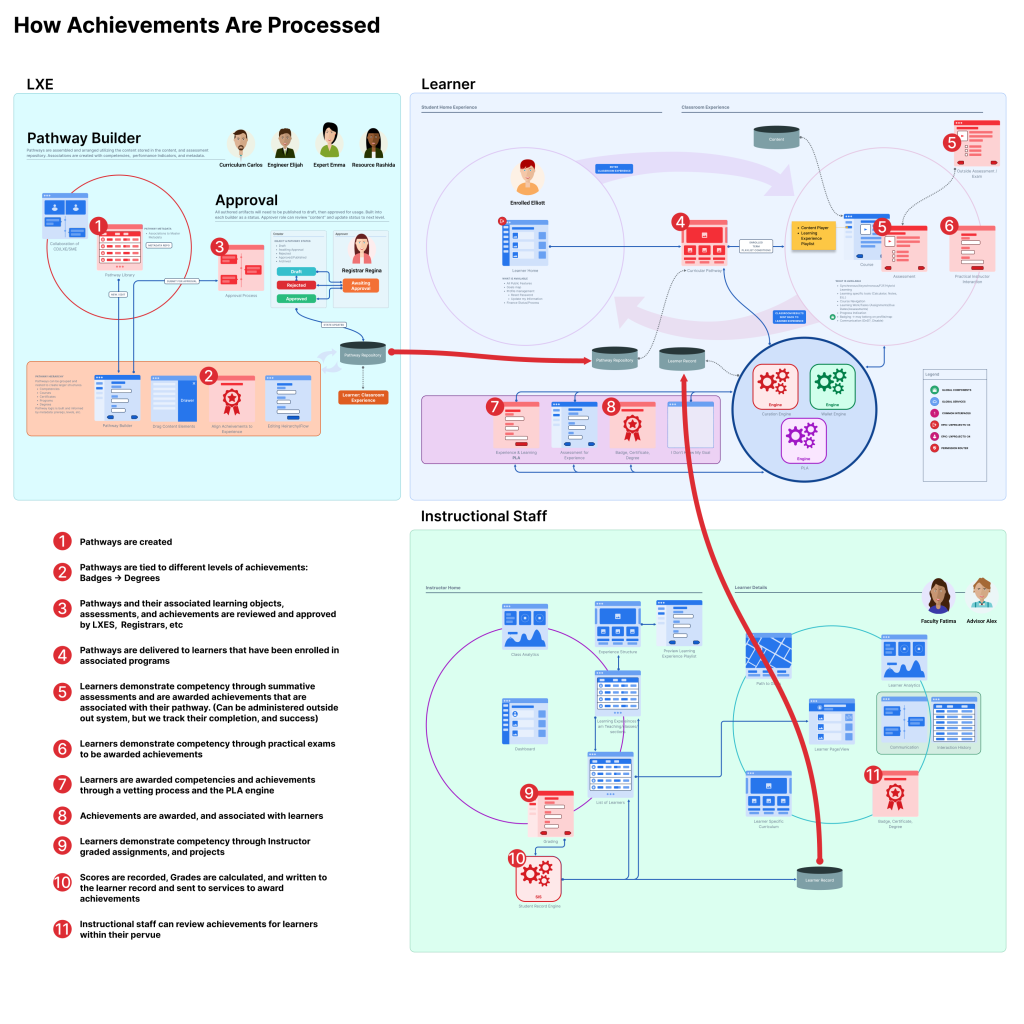
Achievement Process
Communicating how a revolutionary AI-powered credentialing system integrates with existing university governance, so stakeholders could trust and champion the change.
My Role
- System analysis of the achievement and credentialing workflow
- User flows and stakeholder communication artifacts
- Flow diagrams, wireframes, and visual design
- Stakeholder presentations to university leadership
Company: Southern New Hampshire University (SNHU)
Role: UX Architect
Duration: Fall 2022 – Fall 2023
The Project
During the development of the SNHU ecosystem, one of my responsibilities was communicating the complexities of the project to executives. Our team was building something that challenged the existing university’s way of doing things, and this sometimes created tension with stakeholders and other departments. This project was designed to communicate how the new systems were going to fit within the existing process that the university was comfortable with for awarding achievements: credit, certificates, and degrees.
The Challenge
One of our biggest challenges was communicating that the revolutionary system we were building was not going to take people’s jobs or circumvent their authority and responsibilities. One of the most important aspects for the university was ensuring that the degrees bestowed upon learners had value to everyone outside the university. Without this, the degrees and programs would become worthless. The challenge was communicating that the existing systems were still intact, but being processed differently by our system.
Governance constraints shaping the work:
| Constraint | Description |
|---|---|
| External Governance | A committee approves all degree programs |
| Registrar Approval | The registrar’s office reviews and approves all programs before committee submission |
| Competency Definitions | An external university group writes the competency definitions that roll up to degree programs |
Our users in this workflow:
| User | Role |
|---|---|
| Registrar | Approvers of the programs |
| Learning Experience Engineers | Build courses, associate metadata with courses and assessments, and set the achievement for the pathway |
| Learners | Enrolled students participating in the program and earning achievements |
| Instructional Staff | Grade learner work and validate demonstrated competency |
Solution
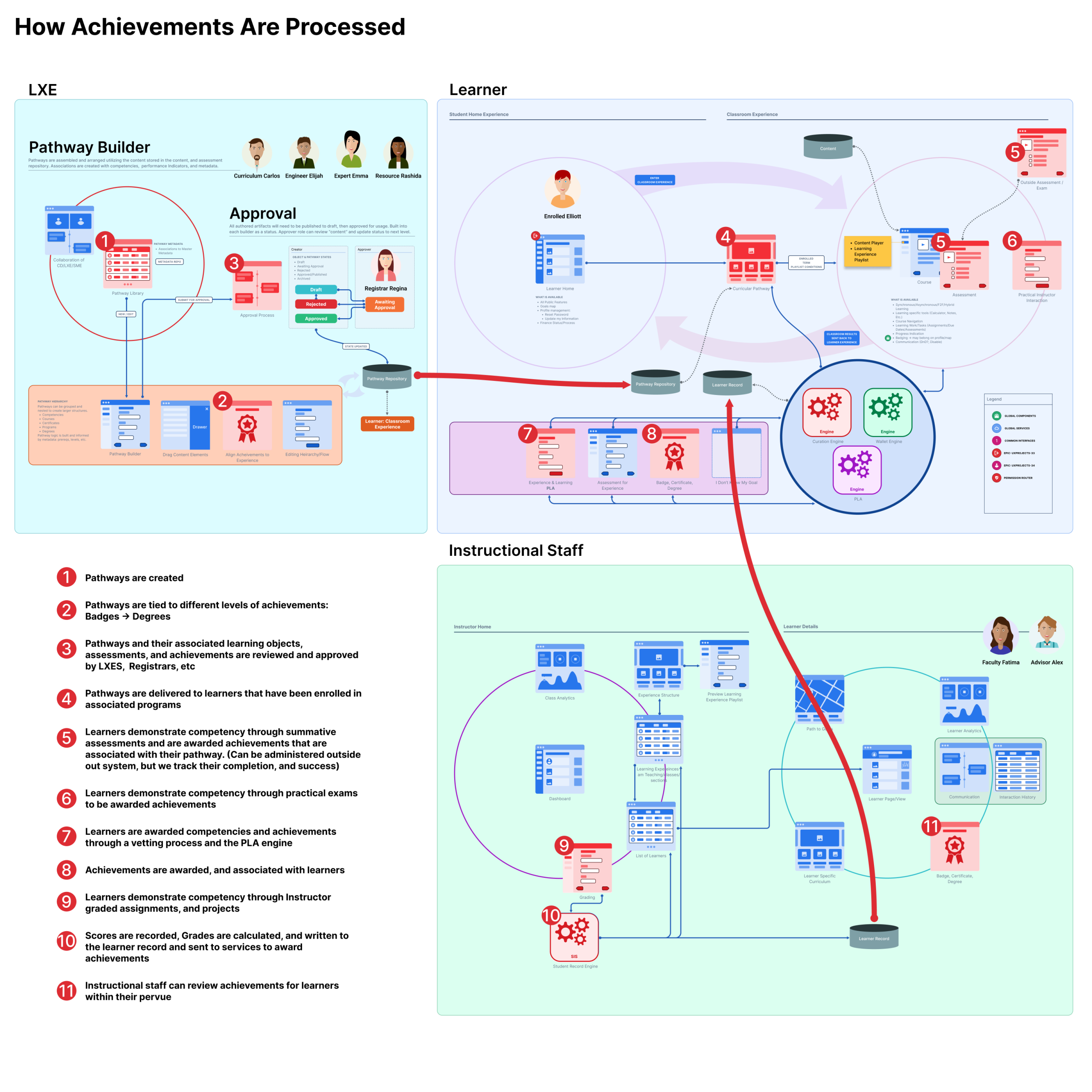
The key difference between our system and the traditional education model is the introduction of more flexible modules of learning. Otherwise, the programs (pathways) are defined and approved, and the assessments and projects prove the learners learned the material. The fundamental governance chain remained intact.
| Authoring Phase | When pathways are authored, achievements are associated with each pathway at creation time |
| Approval Phase | Registrars review the entirety of each pathway to ensure material fulfills requirements approved by the governing committee |
| Grading Phase | In addition to machine-graded assessments, instructional staff review projects, papers, and other work to confirm demonstrated skills and competencies |
The Results
I walked one of our key stakeholders through this flow and addressed her questions. It was successful, and she was able to utilize this diagram to communicate with her peers within the university and her own key stakeholders.
Ideally, this work would have been done upfront to get buy-in across the university. There were several incidents where getting executive sign-off up front would have relieved the university of fear and uncertainty. I was glad I was able to resolve this particular issue. Even revolutionary systems must integrate with existing organizational structures. Clear communication of how new systems preserve important governance processes is essential for stakeholder buy-in.
Related Projects
- AI-Powered Educational Ecosystem — The broader system this process is part of
- Learner UX Architecture — How learners earn achievements through the pathway
- Authoring Platform — How pathways and assessments are built